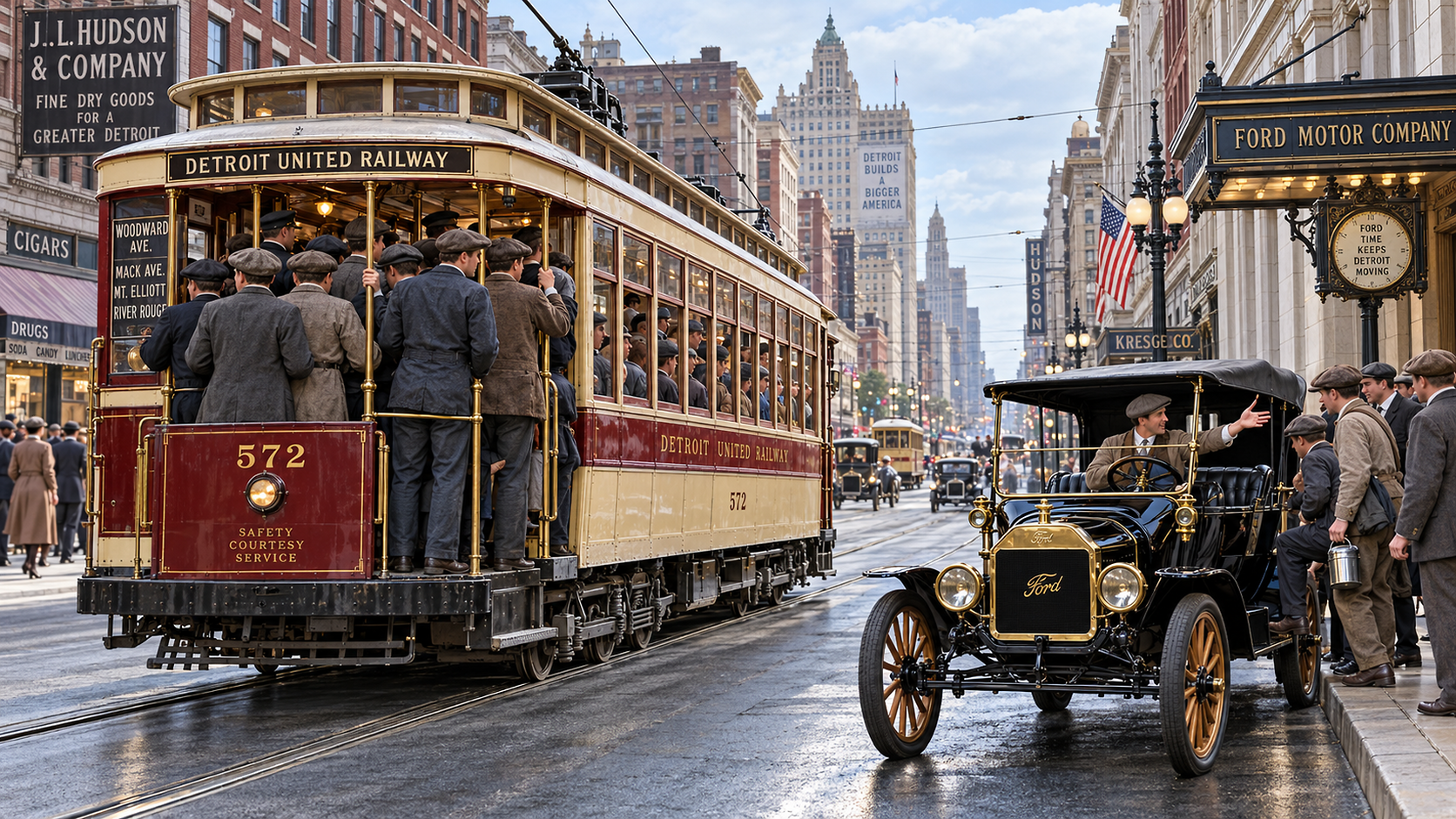
At three o'clock in the afternoon outside the Highland Park Ford plant, the sidewalk along Woodward Avenue dissolved into a stampede of wool caps, lunch pails, and iron-toed boots. Tens of thousands of men poured past the factory gates with pay in their pockets and a long journey home ahead of them. Electric streetcars stood queued on the tracks, their bells clanging uselessly as passengers wedged into doorways and hung off rear platforms. Pulled up against the curb, however, sat a line of privately owned Model Ts, Dodges, and Studebakers, their drivers leaning across passenger seats and holding up flat palms to indicate empty places. For a nickel, and later a dime, a tired drill-press operator could bypass the suffocating crush of the trolley, take a padded seat in a coworker's car, and hurtle south toward the city centre.
A city that outgrew its tracks
Detroit exploded outward in the nineteen-teens. The sudden centralisation of the automotive industry dragged hundreds of thousands of people into a flat, sprawling river basin originally laid out for horse carts, plank roads, and modest electric trolley lines. Between 1910 and 1920, the city population surged from under five hundred thousand to nearly a million, drawing white Appalachian migrants, Black families escaping southern Jim Crow, and tens of thousands of immigrants from southern and eastern Europe. All of them needed to reach factory gates scattered across vast distances, from the riverfront yards to the independent enclave of Highland Park six miles to the north.
The existing public transportation network could not cope with this geographic explosion. The private transit monopoly, the Detroit United Railway, maintained track that was chronically undercapitalised, overcrowded, and frequently paralysed by mechanical failure or winter ice. Commuters stood six deep on street corners watching packed trolleys roll by without stopping. For a worker whose pay envelope was docked if they clocked in five minutes late, the failure of a streetcar was not an inconvenience but an immediate threat to their livelihood. The gap between what the street railway could carry and what the expanding factories demanded created an enormous vacuum along every major roadway.
The nickel car arrives in Michigan
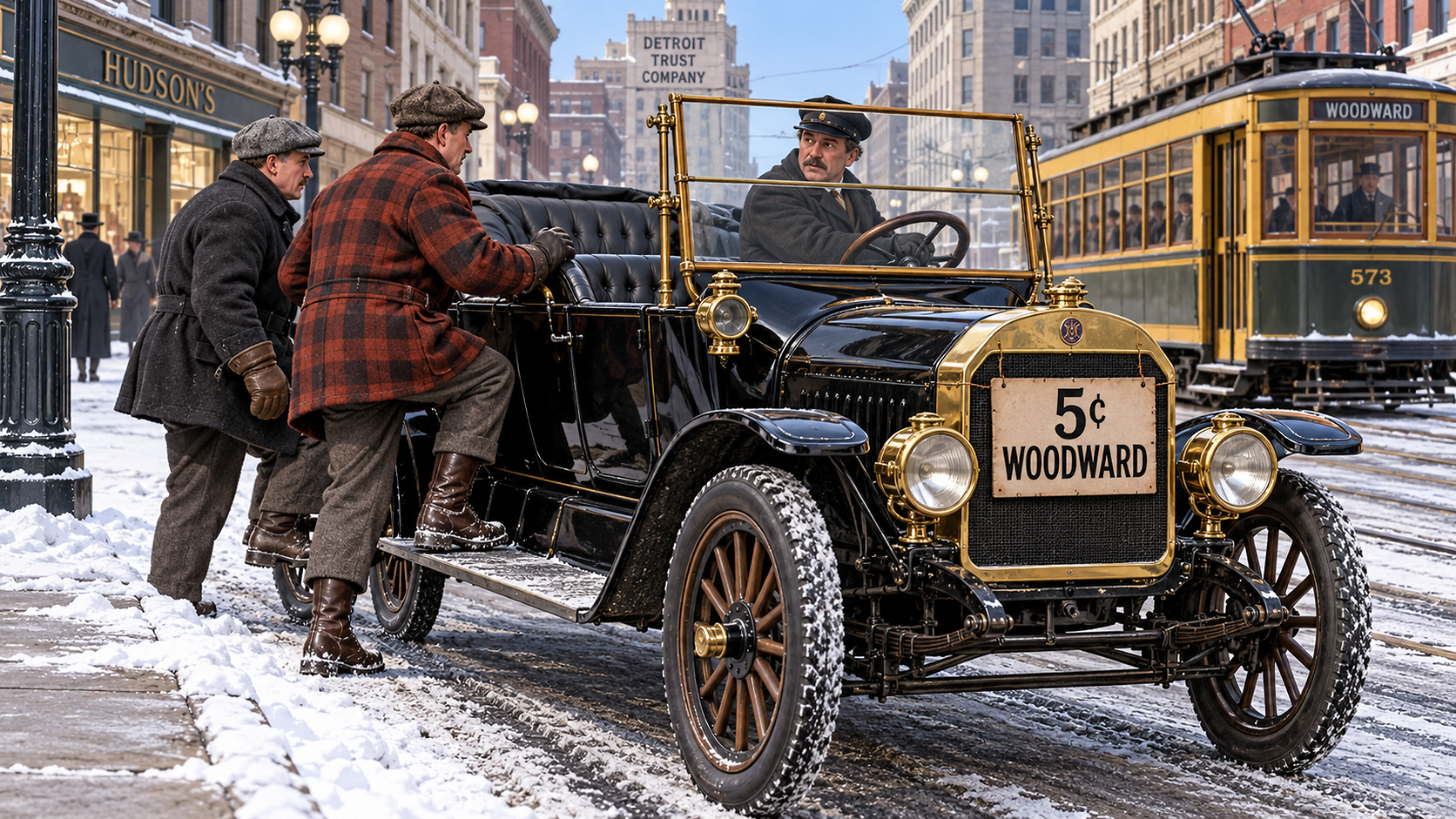
The informal solution arrived in Detroit during the winter of 1914, carried across the country from Los Angeles where the first jitney boom had erupted earlier that year. The concept was disarmingly simple: any person who owned an automobile could fix a hand-lettered cardboard sign to the radiator, tape a paper route notice to the side window, and cruise along established trolley corridors offering fast point-to-point rides for a five-cent nickel. The low fare directly matched the streetcar tariff, but the motor car promised two distinct advantages: heat inside a closed cabin and speeds twice as fast as an electric rail car stuck behind traffic.
In Detroit, the phenomenon spread with astonishing speed because the city had both the vehicles and the mechanical talent in abundance. By 1915, hundreds of touring cars were trolling Woodward, Jefferson, Michigan, and Grand River Avenues, skimming the cream of the rush-hour passenger traffic right off the curb. Street railway motormen found their stops cleared out minutes before their cars could arrive, as jitney drivers sprinted ahead of the trolleys, snatched waiting commuters, and sped away with full passenger loads. What had begun as an opportunistic sideline for unattached motor enthusiasts rapidly solidified into an everyday transit reality for tens of thousands of Detroiters.
Turning assembly line pay into transport capital
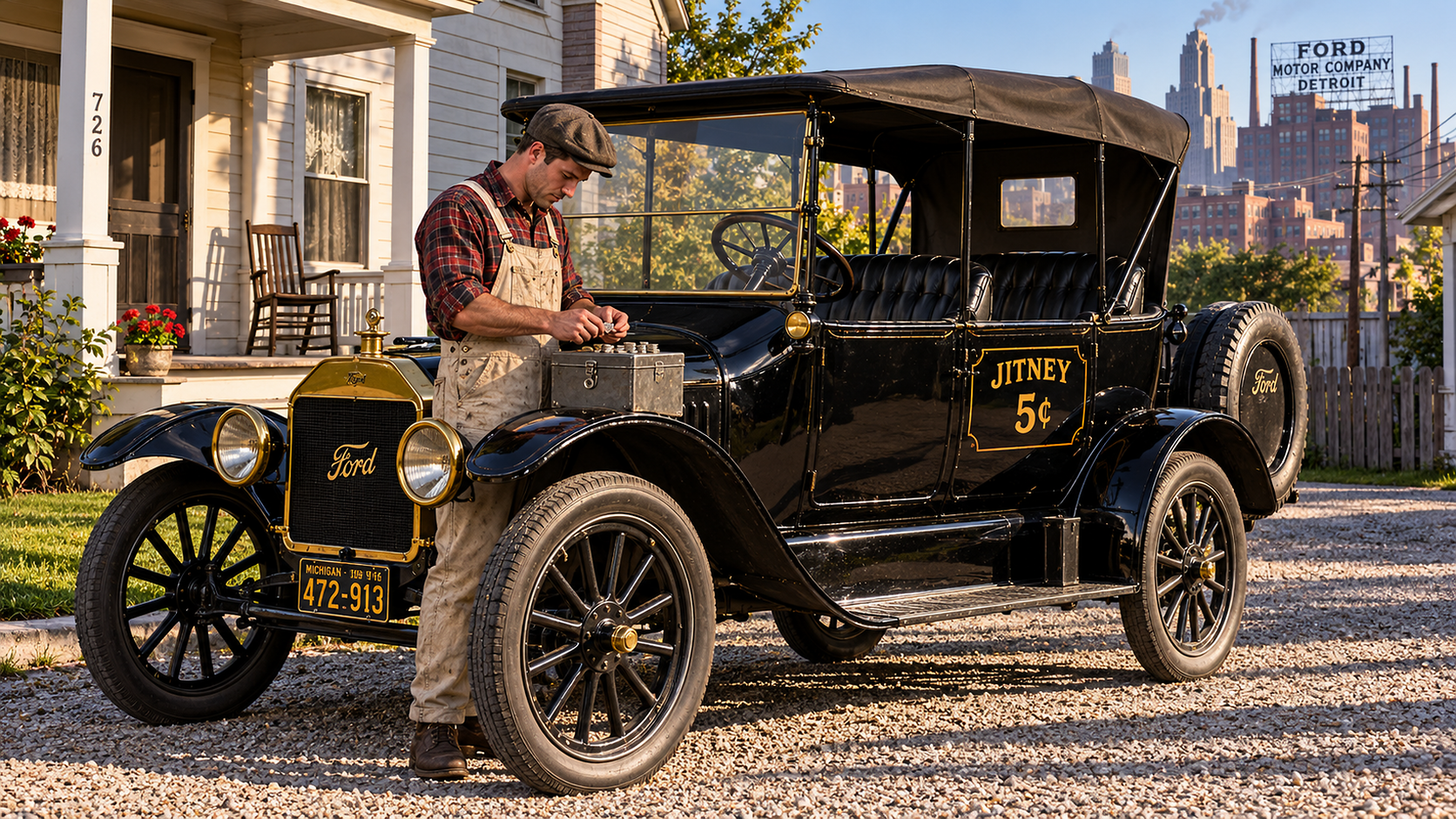
Detroit was the only city in the world where factory hands routinely owned the very luxury products they spent their workdays assembling. Henry Ford’s announcement of the five-dollar daily wage in January 1914 had dramatically compressed the time required for a shop-floor mechanic to purchase a second-hand Model T runabout or even take on instalments for a brand-new touring car. Yet owning an automobile in the nineteen-teens was an expensive undertaking. Tyres shredded regularly on unpaved side streets, engine oil required constant topping up, and monthly payments weighed heavily on workers vulnerable to seasonal plant shutdowns or retooling layoffs.
Turning the family vehicle into a jitney transformed a costly possession into an active capital asset. A press operator or foundry hand off shift could fire up an engine, drive toward the commercial centre, and run three or four round trips before dinner, collecting twenty or thirty nickels per run. On a good Saturday evening or during the chaos of a morning plant shift, a driver could pocket several dollars in cash—money that went straight to paying down the car loan, buying new pneumatic tyres, or cushioning the family against the inevitable periodic layoffs when the lines retooled for the next model year. The car ceased to be a passive consumer item and became an independent engine of family income.
The choreography of the plant gates
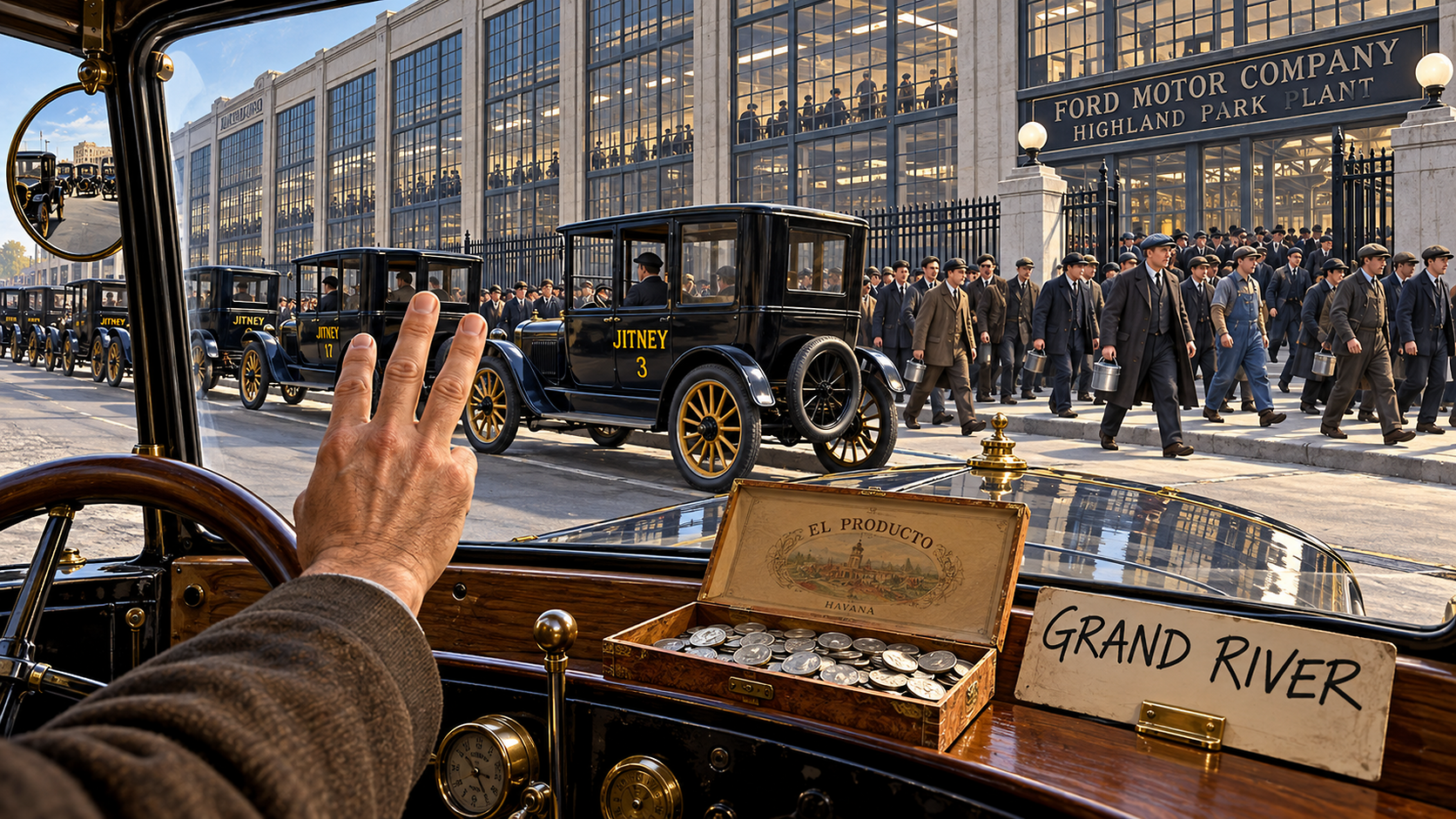
The most profitable and chaotic territory for any Detroit pirate sedan was the immediate perimeter of the great industrial complexes. The Dodge Main complex in Hamtramck, the Packard plant along East Grand Boulevard, and the sprawling Ford Highland Park works were cities unto themselves, discharging ten to fifteen thousand men simultaneously when the whistle blew. The plant gates opened directly onto wide public roads, creating a wall-to-wall press of humanity desperate to disperse across the metropolitan grid before night fell.
Jitney operators mastered the rhythms of these shift changes with military precision. They parked two wheels up on the curb, engine cowls ticking from heat, radiators facing toward the homeward direction of travel. Drivers avoided the delays of making small change or debating destinations by establishing recognised communal protocols. A driver parked near the gate would place a grease-pencil card in the lower corner of the windscreen reading simply Grand River or Woodward South. He would hold three fingers against the glass to show he had three empty places remaining on the leather bench behind him. Passengers scrambled aboard without an exchange of words, tossed their nickels onto the floorboard or into an open cigar box mounted on the wooden dashboard, and the car roared away into traffic while the next pirate sedan slid into the vacant gap along the curb.
A lifeline across divided neighbourhoods
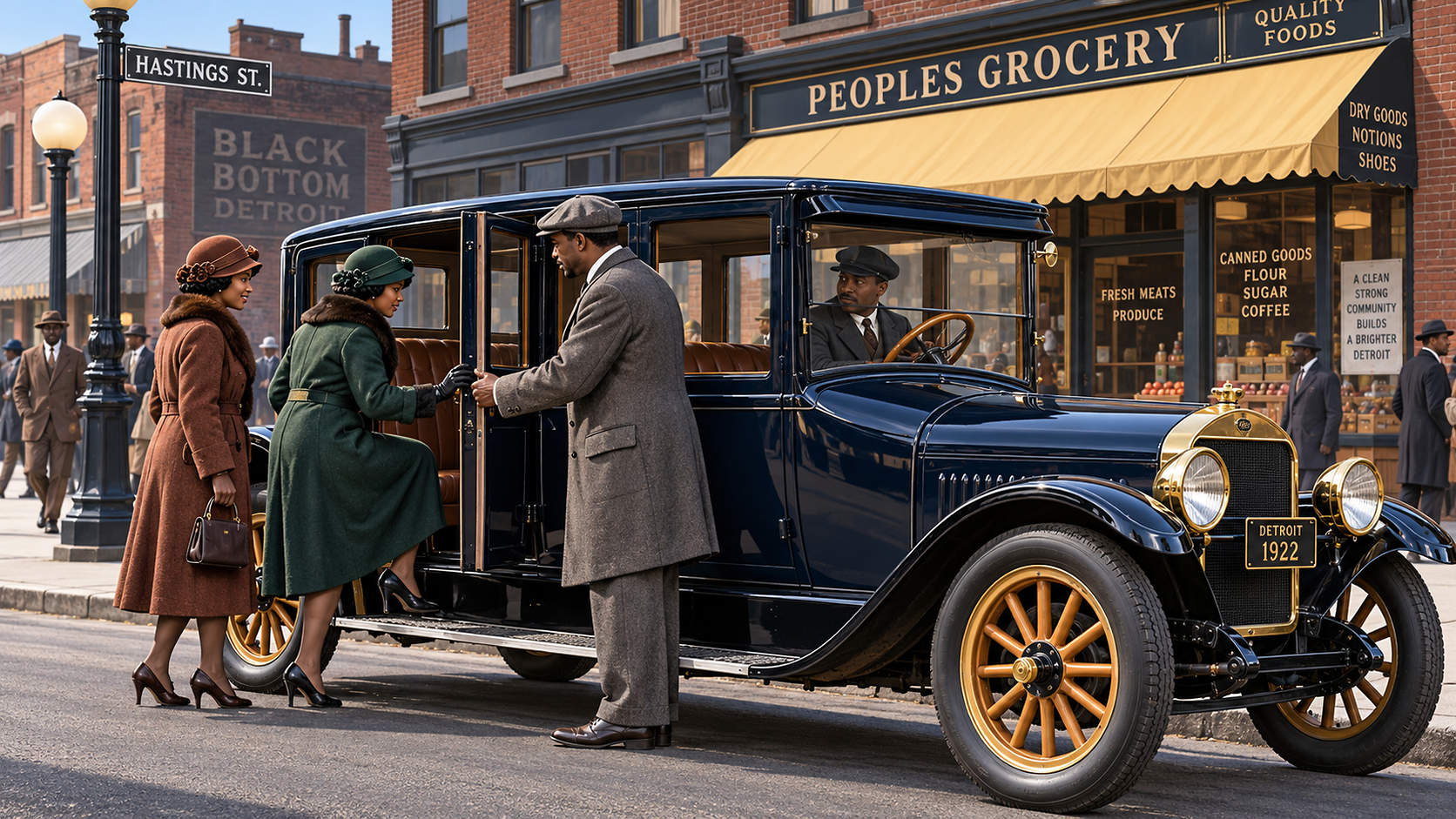
The emergence of informal jitneys in Detroit was deeply tied to the city's unforgiving racial and economic segregation. As Black southerners arrived in massive numbers during the Great Migration to take up hot, hazardous foundry jobs at Ford and other plants, they were largely confined by restrictive housing covenants to overcrowded enclaves like Black Bottom and Paradise Valley on the lower east side. Licensed taxicab companies, which were overwhelmingly white-owned and white-operated, routinely refused to answer telephone calls from these neighbourhoods, and white drivers frequently passed Black workers standing on downtown street corners without stopping.
For Black autoworkers, the pirate sedan was often the only reliable, dignified transit available in the city. Black car owners stepped into the void, establishing dedicated jitney operations running from the plant gates directly down Hastings Street, St. Antoine, and along East Jefferson into the heart of Black Bottom. These drivers charged predictable, fair rates, carried neighbours directly to their doorsteps when weather turned brutal, and bypassed the constant racial friction and hostility that Black passengers regularly endured on crowded public trolleys. In this environment, the jitney became a community institution sustained by mutual reliance.
The trolley company strikes back
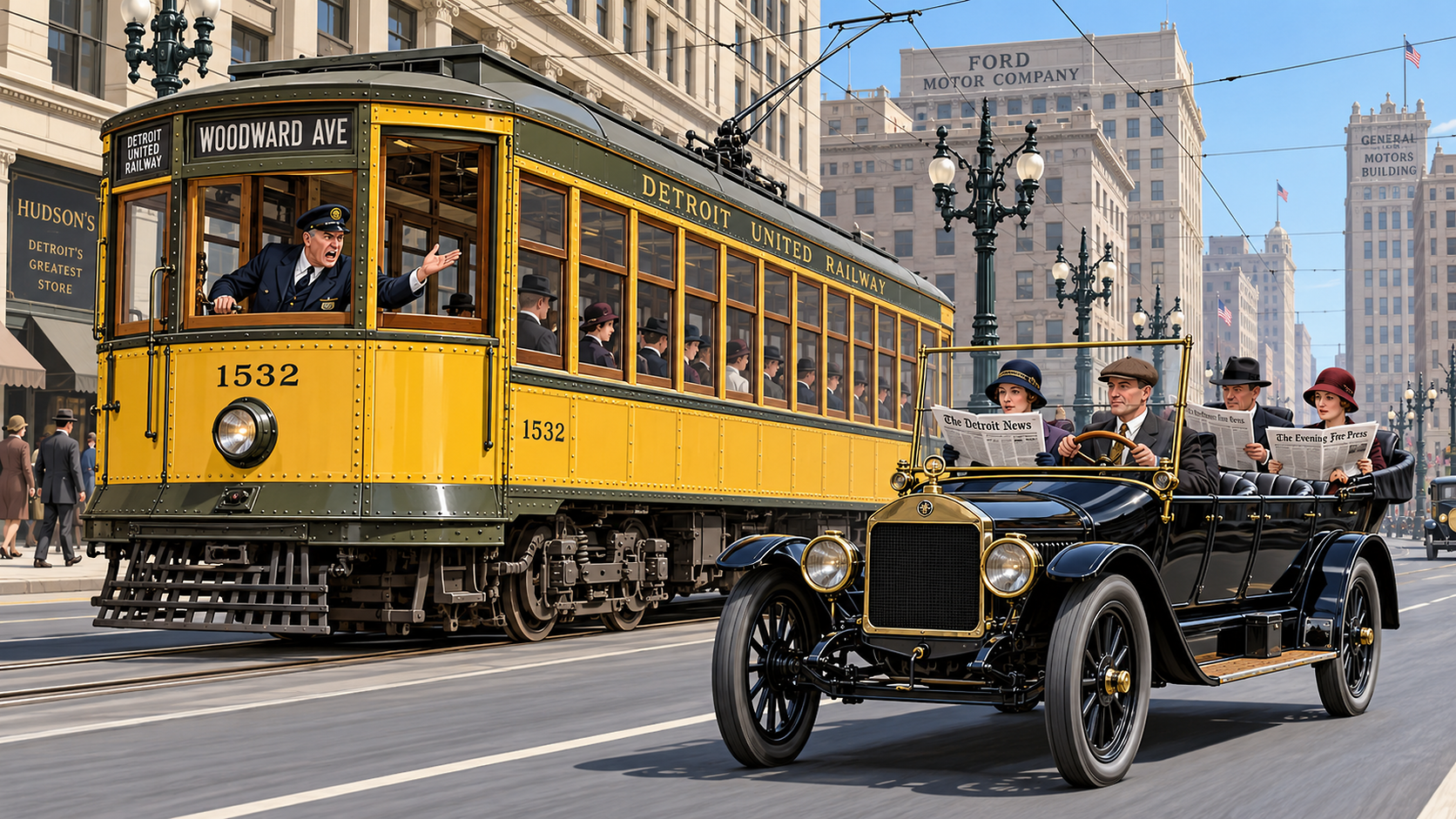
The rapid rise of the pirate sedans did not happen without fierce opposition from established capital. The executives of the Detroit United Railway watched in mounting horror as tens of thousands of lucrative short-haul passengers were stripped away from their lines every single day. The trolley company had heavy overhead costs that jitney men completely avoided: miles of steel rails to maintain, overhead electrical wires to inspect, city paving taxes along the tracks, and substantial property tax bills on carbarns and substations. The informal sedan, by contrast, operated on publicly funded macadam and asphalt without paying a cent in franchise fees.
The streetcar lobby launched a fierce public relations campaign to demonise the jitneys, branding them as reckless road pirates, traffic menaces, and unregulated public safety hazards. Company spokesmen argued that private touring cars jammed downtown bottlenecks, caused horrific collisions when darting across tram tracks, and operated without passenger insurance. If an uninsured jitney driver sheared off a wheel or pinned a pedestrian against a lamppost, the injured victim was left with no legal recourse against a penniless factory hand. The railway company insisted that the jitneys were parasites skimming off profitable rush-hour fares while leaving the electric railway with the unprofitable burden of running empty cars through the dead of night and serving remote, thinly populated suburbs.
The city buys the tracks
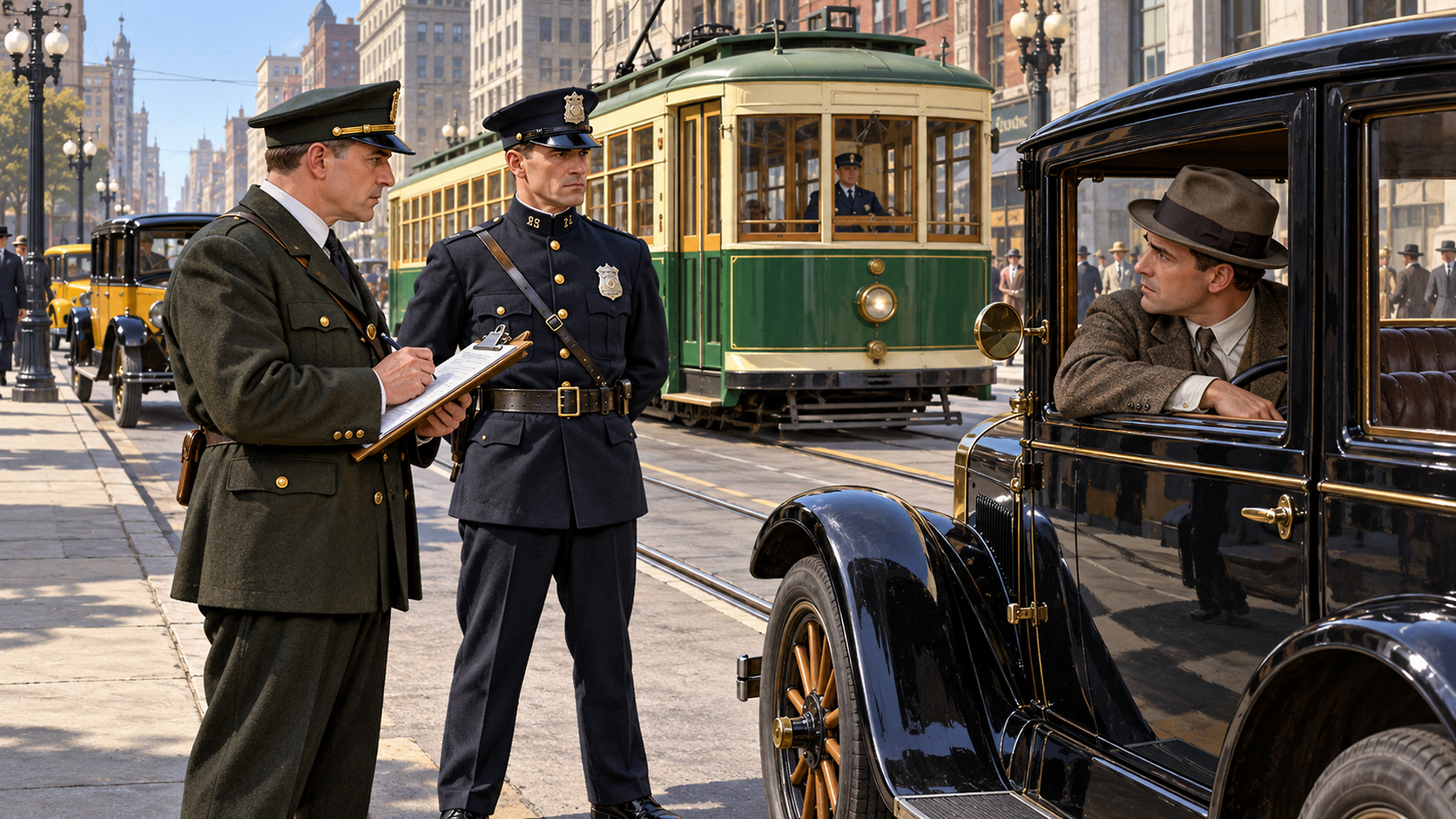
The conflict entered an even more volatile phase in 1922 when the City of Detroit took the historic step of buying out the Detroit United Railway and creating the publicly owned Department of Street Railways, known across the city as the DSR. The driving force behind municipalisation was Mayor James Couzens, a former general manager of the Ford Motor Company who had grown fabulously wealthy before turning his ruthless organizational energy toward city hall. Couzens had promised Detroiters that public ownership would finally bring modern, affordable, and comprehensive rail service, ending decades of private transit incompetence.
Having pledged the city's credit to purchase the trolley lines, the municipal government suddenly found itself in the awkward position of protecting its own transit monopoly. Every fare lost to an informal jitney was no longer shaving private utility profits; it was draining money from the city treasury and threatening the municipal bond payments used to buy the tracks. Almost immediately after the city takeover, Mayor Couzens and the Detroit Common Council turned their regulatory weapons on the jitney operators. In May 1922, the council passed a sweeping ordinance designed to crush informal street hire entirely, banning all jitneys from Detroit's primary avenues and imposing steep criminal fines on any unauthorised driver picking up passengers on public streets.
Six years of legal trench warfare
Rather than vanishing from the streets, Detroit’s jitney drivers organized one of the most stubborn resistance campaigns in American urban transit history. Thousands of individual operators pooled their nickel earnings to establish formal cooperative mutual-aid bodies, most notably the Red Star Motor Drivers’ Association and the Blue Ribbon Association. These organizations were not loose street gangs; they were legally incorporated bodies that hired first-rate municipal attorneys, retained legal counsel on permanent retainer, and established mutual bail funds to defend members who were arrested by the Detroit police.
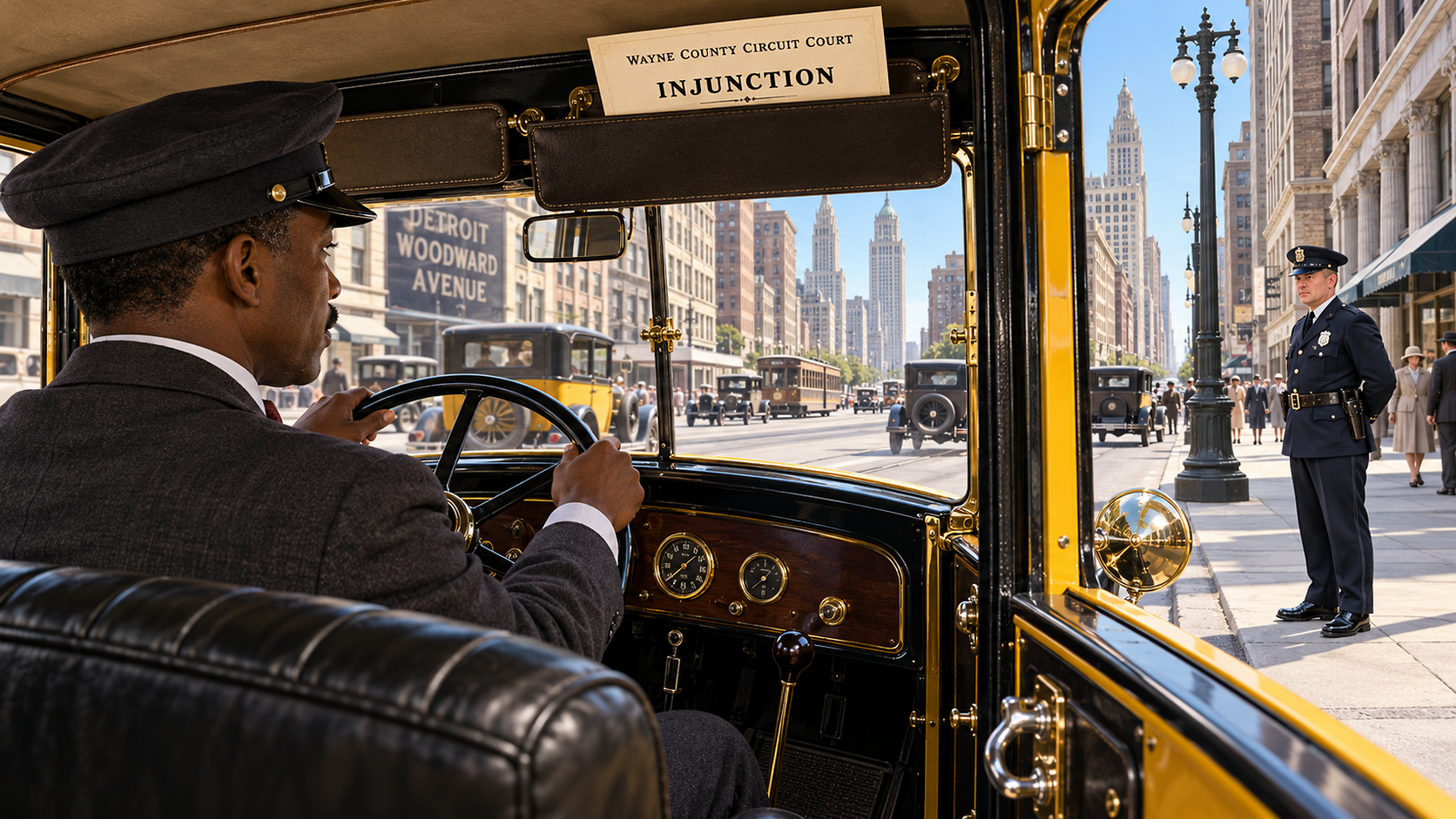
The associations struck back against the 1922 ordinance not with wildcat street violence, but through the courts. Within days of the law's passage, the jitney lawyers marched into Wayne County Circuit Court and secured a preliminary injunction that restrained the city and the police commissioner from enforcing the ban, arguing that the ordinance was unconstitutional, confiscatory, and an arbitrary abuse of municipal power. For the next six years, an astonishing legal stalemate reigned over Detroit's avenues. While the city appealed through every level of the state judiciary, the injunctions remained active. More than a thousand pirate sedans continued to cruise Woodward and Jefferson Avenues under open judicial protection, their drivers carrying formal court cards tucked above their sun visors to ward off harassment from city police.
How an informal jitney route operated
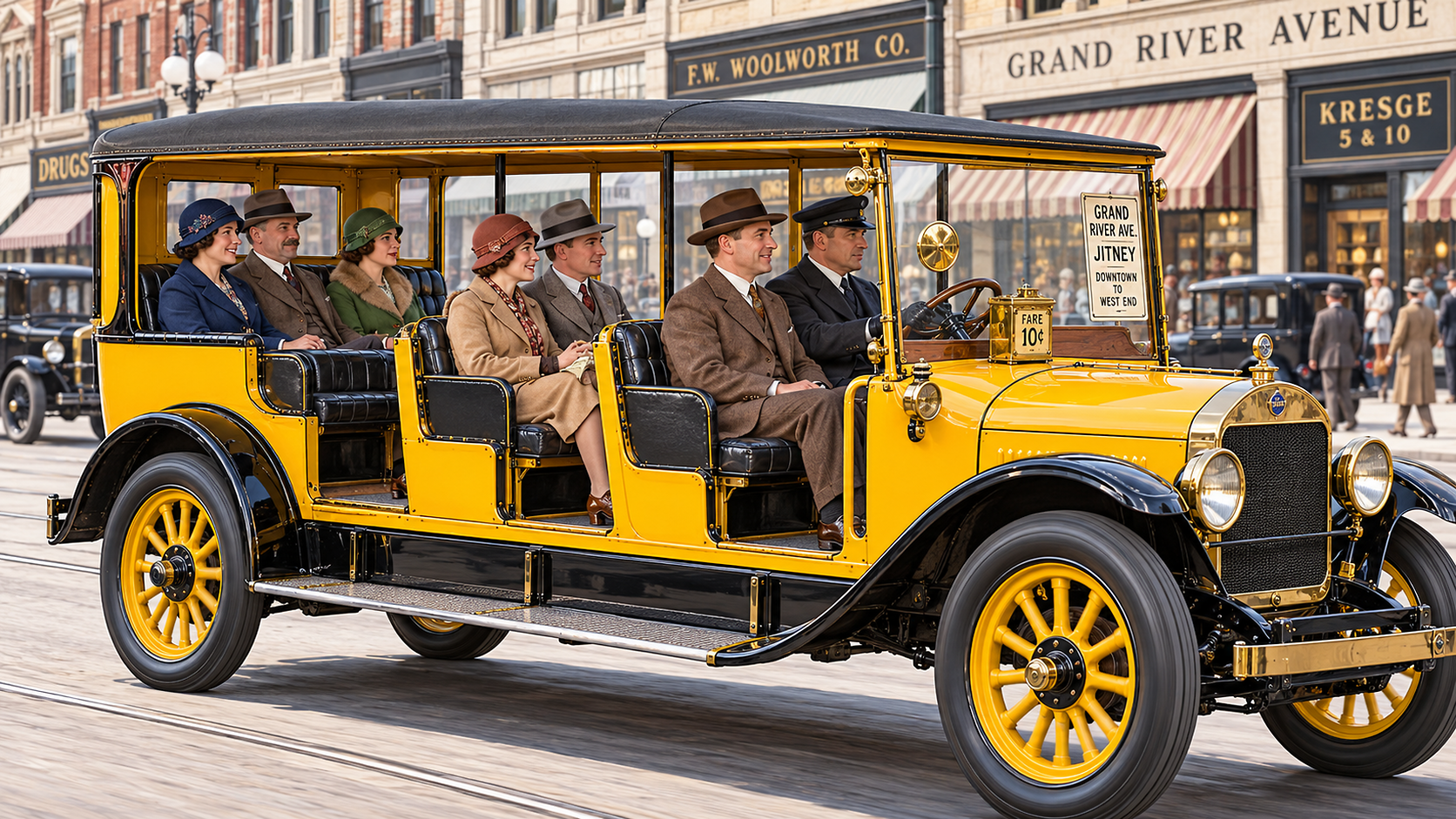
During the long heyday of the court injunctions, the Detroit jitney trade operated with the discipline of an unwritten timetable. Drivers did not roam the city looking for solitary fares like modern metered cabs. Instead, they ran fixed linear routes, duplicating the main radial paths of the streetcars. A driver running the Grand River route would leave the downtown loop near Campus Martius and drive straight out to the city limits at Joy Road and back, never turning down residential cross-streets regardless of what an individual passenger offered to pay.
Passengers knew precisely where to stand along the curb to catch specific runs. Because stopping at every street corner ruined a driver's speed, jitneys stopped only at major commercial transfer points or when an exiting passenger tapped firmly on the glass of the partition window. The speed was breathtaking compared to the streetcars. While a steel trolley car ground along through traffic at an average speed of eight to ten miles per hour including stops, a fleet-footed pirate sedan could hit twenty-five or thirty miles per hour down open avenue lanes, cutting the commute time from Highland Park to downtown Detroit from forty minutes to under twenty.
By the mid-nineteen-twenties, the standard fare had stabilized at ten cents—twice the price of the trolley, but well worth the premium for passengers who valued their time or wished to avoid standing cheek-by-jowl in unventilated streetcar cabins. Drivers typically carried five passengers in a standard sedan, or up to eight in elongated seven-passenger touring cars equipped with drop-down jump seats in the middle compartment. A diligent driver working ten hours could take fifty dollars a week in gross revenue, out-earning many skilled toolmakers on the factory floor.
Sunday repairs in back alleys
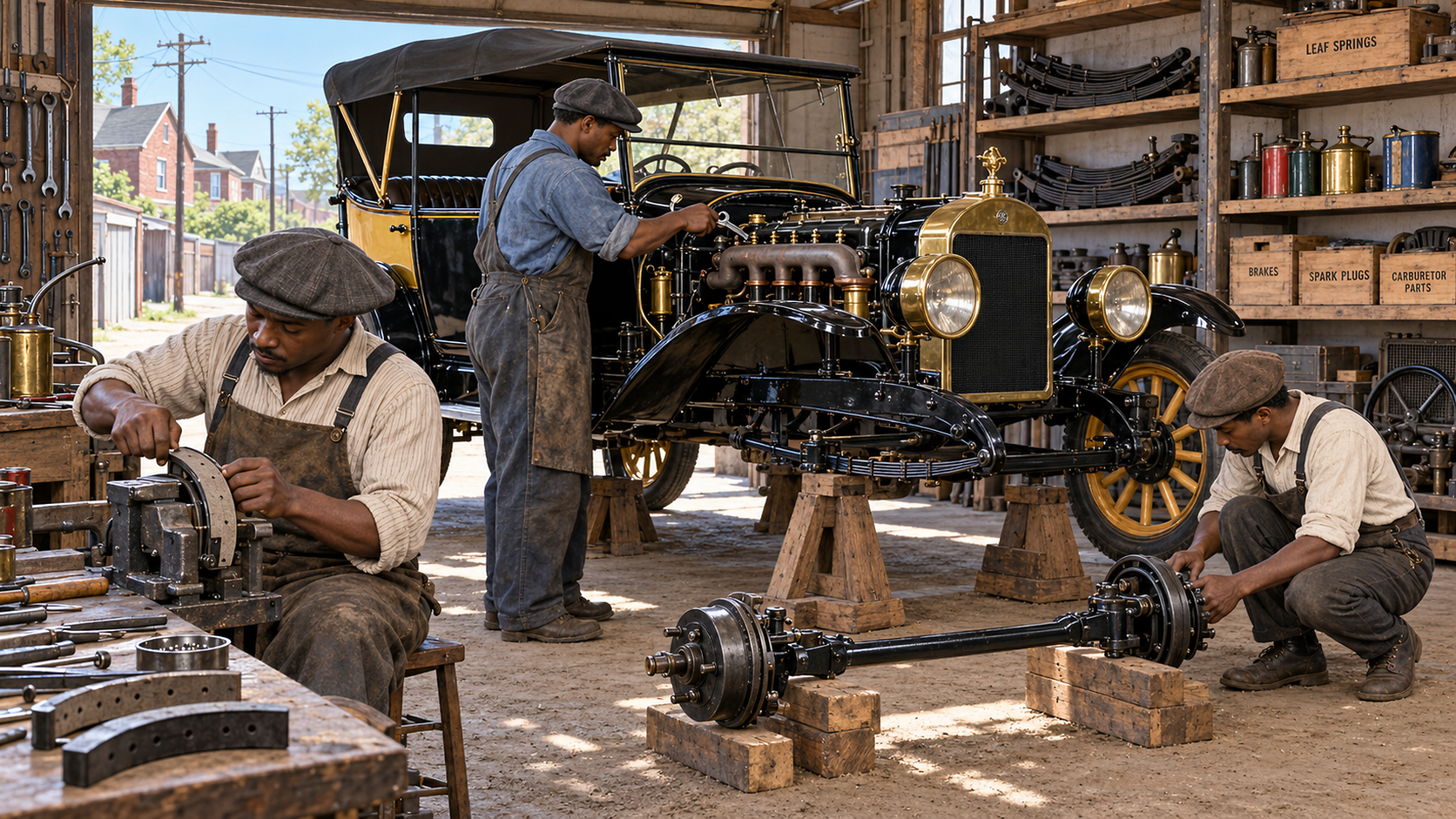
Operating an automobile under the relentless pounding of the jitney cycle was brutal on mechanical machinery. Detroit's roads were cratered by heavy coal trucks and winter frost-heaves, while constant stopping and starting destroyed transmissions, warped brake bands, and cracked leaf springs. The pirate transit trade was only economically viable because the drivers themselves were expert mechanics who had spent years assembling engines and chassis on the production lines of Chrysler, Dodge, and Ford.
The real maintenance work of the jitney fleet took place in the dirt-floored alley garages of Detroit's residential neighbourhoods on Sunday mornings. Drivers gathered in loose mutual-aid rings, trading salvaged parts, swapping engines, and re-lining brake shoes using scrap materials brought out through factory gates. An autoworker knew exactly which scrap yard in Southwest Detroit had front axles from a wrecked Buick Master Six, and which fellow jitneyman had a machine lathe in his basement capable of turning a worn brake drum. This technical infrastructure kept vehicles on the road that any ordinary commercial fleet operator would have scrapped as completely unviable.
The legal axe falls in 1928
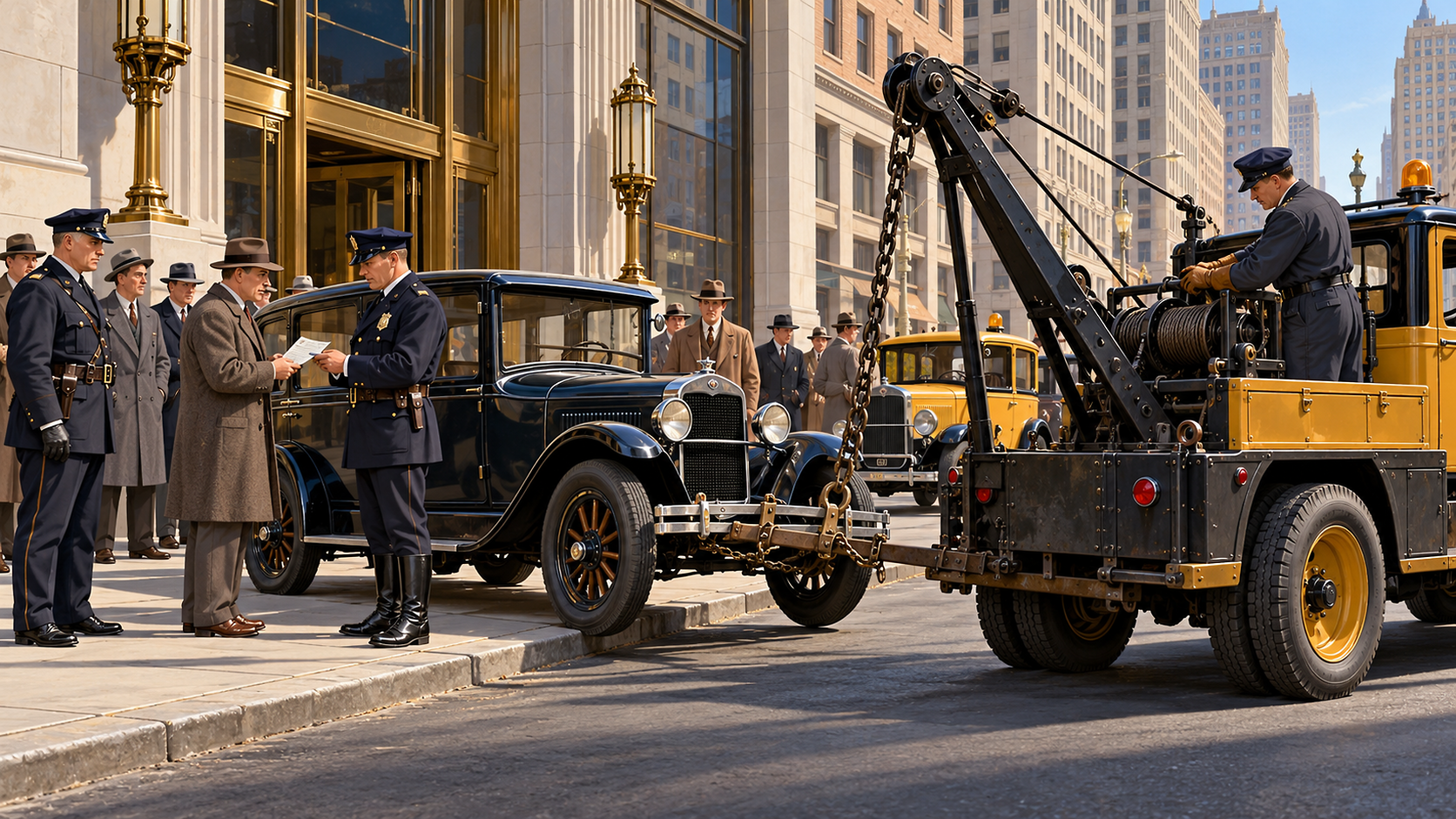
The six-year era of court-protected informal transit came to an abrupt, decisive end in October 1928. The Supreme Court of Michigan finally delivered its long-delayed verdict in the landmark case of Red Star Motor Drivers’ Association v. City of Detroit. The court ruled comprehensively in favour of the municipal government, declaring that while individual citizens enjoyed an ordinary right to use the public highways for travel, they possessed no inherent constitutional right to use those public highways as an unfranchised place of private business. The city, the justices affirmed, held total sovereign authority to manage, regulate, or outright ban commercial passenger carriers from its streets.
The legal shield vanished overnight. Detroit Police Commissioner William Rutledge issued immediate orders to impound any private vehicle caught picking up roadside passengers along the primary avenues. Police squads set up observation posts along Woodward, Michigan, and Grand River, sweeping dozens of drivers into precinct cells and towing their sedans to municipal storage yards. Within days, the high-profile, organized jitney trade that had dominated Detroit's central avenues for over a decade disappeared from view. The Department of Street Railways proclaimed total victory, reclaiming its monopoly over mass transit across the metropolitan area.
Depression pirate hacks
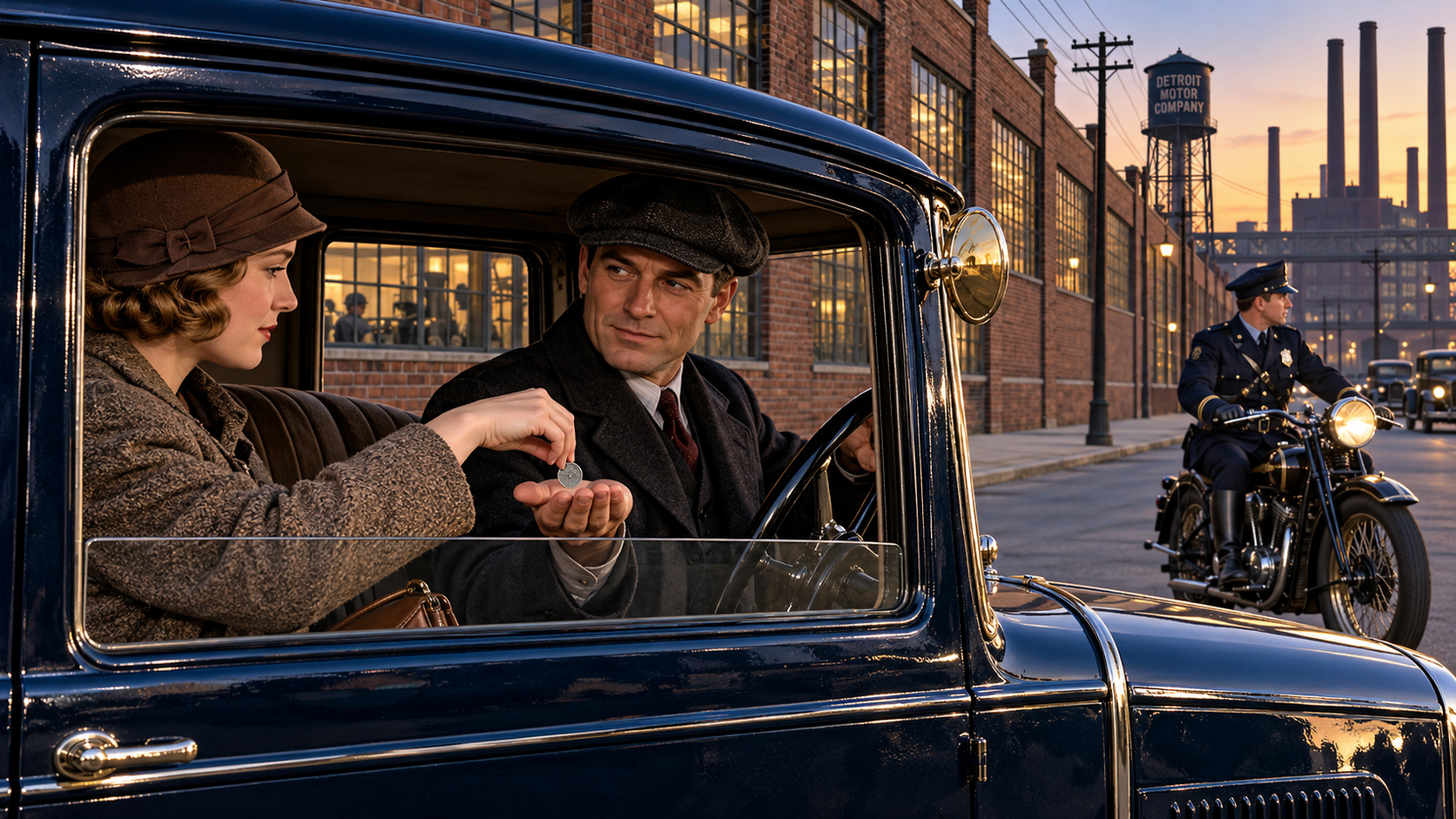
The legal ban broke the open public presence of the jitneys, but it could not extinguish the economic pressures that created them. Exactly one year after the Michigan Supreme Court's ruling, the Wall Street stock market collapsed, plunging Detroit into the darkest industrial crisis in American history. As the automobile factories laid off two-thirds of their workforces and slashed wages for those remaining, formal employment dissolved. Thousands of autoworkers found themselves with empty cupboards, expired mortgage notes, and an old sedan sitting in the driveway.
Inevitably, the pirate cars returned, abandoning the visible central avenues and retreating into an underground guerrilla economy. Displaced autoworkers took up station along the perimeter of the plants that were still operating, running bootleg rides for pennies to transport remaining shifts to and from the River Rouge plant or the Briggs manufacturing facilities. These Depression-era pirate sedans operated under extreme caution, stripping away all route cards and exterior signs. Passengers entered through the front passenger door to make the car look like a group of coworkers carpooling, and payment was slipped discreetly into gloveboxes or transferred hand-to-hand outside the vision of patrolling motorcycle officers. The pirate car had returned to its original status: a sheer survival tactic for families fighting off outright destitution.
The long shadow of informal street hire
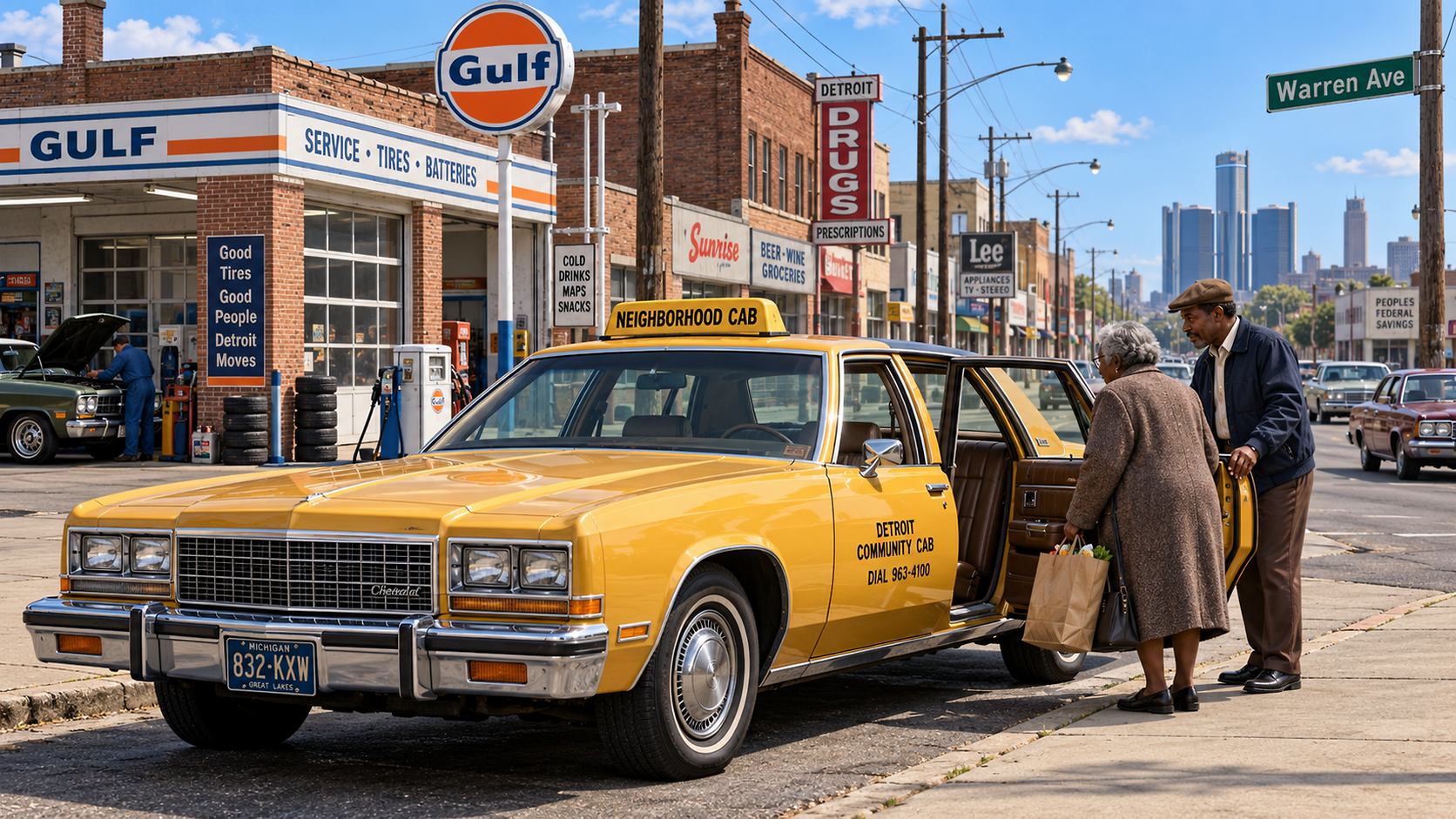
The legacy of the autoworker jitneys left a permanent imprint on Detroit that persisted long after the city dismantled its streetcars in the nineteen-fifties and replaced them with municipal buses. The vast, low-density layout of the Motor City, combined with the continuous erosion of public transit funding in the latter half of the twentieth century, ensured that official transportation never truly served the everyday needs of Detroit's residential working-class neighbourhoods. Informal car networks remained an indispensable part of civic life.
Throughout the nineteen-sixties, seventies, and beyond, unlicensed pirate cabs, known across Detroit simply as 'hacks,' continued the tradition forged by the Model T drivers of 1914. Operating out of neighbourhood storefronts, corner gas stations, or simply cruising along major east-west corridors like Seven Mile and Warren Avenue, hack drivers provided transit where municipal buses were unreliable and commercial cab companies refused to go. The men who had turned their private family cars into transit vehicles outside the Highland Park gates in the nineteen-teens established an informal network of working-class transit that proved far more durable than the streetcar tracks they competed against.

Further reading
Follow the source trail. These references offer a starting point for exploring the records beyond our editorial interpretation.
Detroit Department of Street Railways records, Burton Historical Collection, Detroit Public LibraryExternal reference · Opens in a new tab Automotive History Collection, Detroit Public LibraryExternal reference · Opens in a new tab Michigan State Supreme Court records: Red Star Motor Drivers' Association v. City of Detroit (1928)External reference · Opens in a new tab